
Introduction
Autoclaved Aerated Concrete Blocks or AAC blocks are lightweight, precast, and durable building materials; available in various sizes and qualities. The Autoclaved Aerated Concrete or AAC material was first developed in Sweden in 1924 and is a highly successful building material in Europe and worldwide. The substances used in producing Autoclaved Aerated Concrete blocks are lime, sand, cement, water, and a small amount of rising agent, which is organic and eco-friendly.
Autoclaved Aerated Concrete or AAC blocks are the most preferred building material for construction projects. These blocks have set a different standard in the construction industry. They are cost-effective and sustainable; hence their demand is also high in the market. With this background, let’s reveal the benefits of Autoclaved Aerated Concrete Blocks in the construction industry-
Description
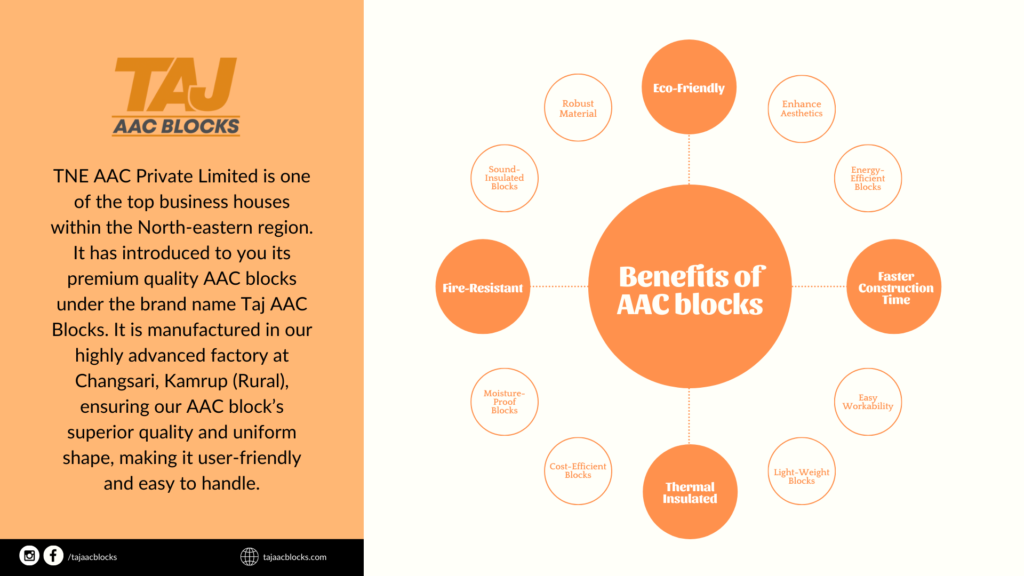
- Autoclaved Aerated Concrete blocks are an eco-friendly building material. The use of recycled industrial waste (fly ash), non-toxic ingredients, non-emitting gases, and fewer energy consumptions makes the AAC Blocks eco-friendly and sustainable. Therefore, they help in reducing at least 30% of environmental waste, unlike traditional blocks.
- Autoclaved Aerated Concrete blocks are easily accessible; no matter the season, their production is always over the odds. The mass production of AAC blocks happens in autoclaves within the factories.
- Autoclaved Aerated Concrete Blocks are valuable building materials comprised of excellent thermal insulation because their honeycomb-like tiny air pores give cellular structure to the blocks. Thus, AAC blocks help in reducing the heating and air-conditioning costs of the building.
- Autoclaved Aerated Concrete blocks facilitate faster construction and reduce construction time by 20%. Their availability in different sizes helps in reducing the number of joints in the wall masonry. AAC blocks are also elementary to install as well as sets and hardens quickly.
- Autoclaved Aerated Concrete blocks are comparatively lighter than conventional blocks and easy to transport. The usage of AAC blocks reduces the overall dead load of the building, hence ensuring the construction of taller and more substantial buildings.
- Working with Autoclaved Aerated Concrete blocks is relatively effortless. Regular masons with fundamental training can work with AAC blocks perfectly. The blocks are easy to cut, drill, and nail to fit individual requirements.
- The use of Autoclaved Aerated Concrete blocks reduces the construction cost by 30% approx. Besides being a cost-efficient material, it also decreases the load on reinforced concrete blocks by 10%-15%.
- Autoclaved Aerated Concrete blocks contain discontinuous air pores which do not allow water to pass through them. AAC blocks do not absorb water like red or clay bricks, as the other soak a lot of water due to their high capillary action.
- The moisture-proof attribute of Autoclaved Aerated Concrete blocks don’t allow termites, mold, and mildew to nest and grow. AAC blocks also avoid external and internal sources of moisture, which can cause damage to buildings or establishments.
- Autoclaved Aerated Concrete Blocks have excellent sound absorption quality due to their porous structure, allowing sound attenuation of about 42dB blocking sound and disturbance from outside. That’s why it is ideal for constructing hospitals, schools, hotels, and other structures that require acoustic insulation.
- Autoclaved Aerated Concrete blocks manufacturing process gives an excellent strength besides maintaining its lightweight property and offers steadiness to the structure. These blocks will provide a ‘robust build’ and a ‘comfortable living experience’ for the decades to come.
- Autoclaved Aerated Concrete blocks have an attractive appearance and are usually adaptable to any architecture. In addition, these blocks will enhance architectural creativity and offer unique designs.
- Autoclaved Aerated Concrete blocks are harmless products that will not pollute the air, land, or water. Waste from the cutting process is recycled and used again during manufacturing, causing less pollution. The energy consumed in the production process is only a fraction compared to the production of other materials.
Conclusion
Consequently, as mentioned earlier, the benefits make the Autoclaved Aerated Concrete a suitable choice for construction projects. The substances used in AAC blocks further lead to faster, economical, and maintenance-free robust build. AAC blocks have higher workability and flexibility standards, making them widely used blocks in the construction industry for residential, non-residential, schools, healthcare, and other commercial and industrial structures. Hence, due to these benefits, AAC blocks have captured a stronghold in the construction industry.
About Taj AAC Blocks
TNE AAC Private Limited is one of the top business houses within the North‐eastern region. It has introduced to you its premium quality AAC blocks under the brand name Taj AAC Blocks. It is manufactured in our highly advanced factory at Changsari, Kamrup (Rural), ensuring our AAC block’s superior quality and uniform shape, making it user-friendly and easy to handle.