

Red bricks are commonly used for construction and consider one of the most popular building materials, especially in developing countries. The reasons behind its popularity are Durability, Cost-effectiveness, Easy handling attributes. The conventional red clay bricks are fabricated using the topsoil of the earth surface. However, the rigorous consumption of topsoil may lead to the infertility of soil; moreover, during the production process, toxic gases are released heavily which make red bricks an unsuitable option for construction projects. Due to these reasons, there is a need for an alternative and the Autoclaved Aerated Concrete block comes as a solution. AAC blocks are an eco-friendly product because the material used in the manufacturing of these blocks are fly ash, lime, gypsum and sustainable in nature, unlike the red bricks which are not eco-friendly. In the present day, research has led to the innovation of more eco-friendly construction products like AAC blocks, CLC blocks, solid concrete blocks, etc. The fly ash used in the AAC blocks is a by-product so it is beneficial for the environment to use fly ash in the block. The AAC blocks have higher strength and durability as compared to the red bricks and are always in high demand due to their eco-friendly and long-lasting properties. Now, let’s find out the major differences between AAC blocks and red bricks.
Description
In terms of Compressive Strength:
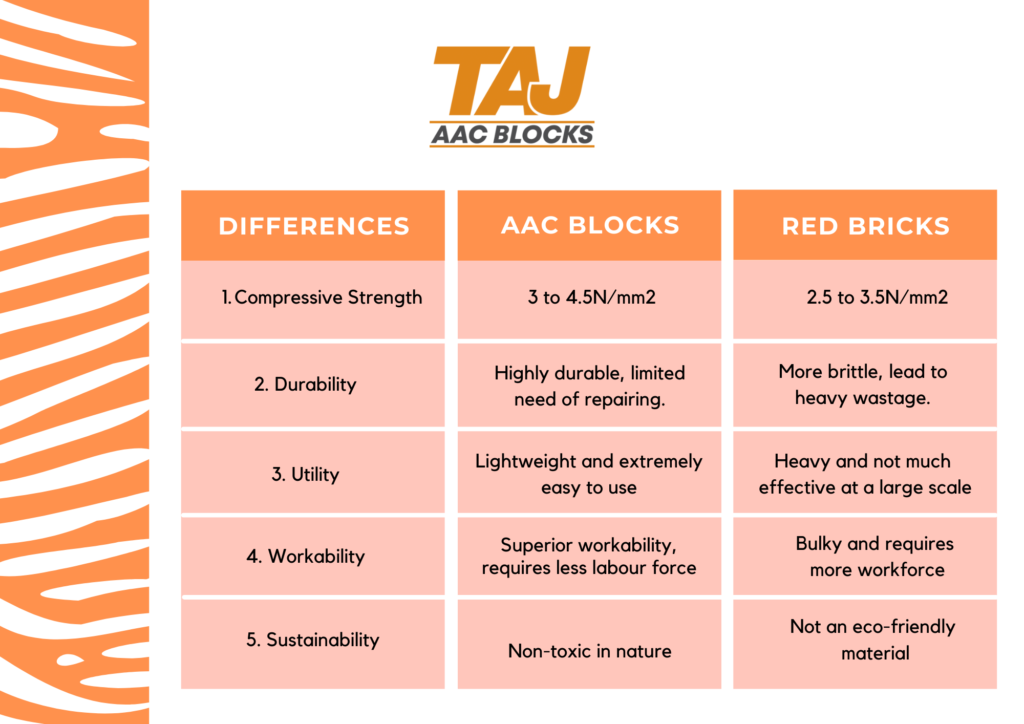
Autoclaved Aerated Concrete blocks are manufactured in specialized factories and simultaneously designed and developed. On the other hand, red bricks are easily found across all the regions and hence they do not offer the compressive strength when compared to AAC blocks. The AAC blocks are specifically designed to be more resilient to compressive load. Red Bricks offers a compressive strength of about 2.5 to 3.5N/mm2, whereas AAC blocks provide 3 to 4.5N/mm2 of compressive strength.
In terms of Durability:
Autoclaved Aerated Concrete blocks are specifically designed to be more durable and also more uniform which strengthens the entire structure considerably. Red Bricks are much more brittle than AAC blocks which can lead to heavy wastage as well as faults within the overall construction. Using AAC blocks, builders as well as developers can increase the lifespan of the establishment/buildings. These blocks also ensure that there is a limited requirement of maintenance and repairing.
In terms of Utility:
Autoclaved Aerated Concrete blocks are lightweight and extremely easy to use, which helps in the expansion of their utilization among construction sites. On the other hand, red clay bricks are heavy, bulky and not much effective at scale. As AAC blocks are thinner, the available carpet area of the building/establishment increases.
In terms of Workability:
Autoclaved Aerated Concrete blocks are having lighter weight with higher strength which offers superior workability across all construction projects and requires less labour force. This eventually lessens labour costs enabling a good amount of cost savings at scale. When using AAC blocks, the number of joints is less which again results in a considerable savings of mortar as well as boosting construction speed unlike the red bricks.
In terms of Sustainability:
The Red Bricks are not as eco-friendly as Autoclaved Aerated Concrete Blocks. Single sq. ft of red bricks walling can consume approximately 25kg of topsoil which negatively impacts the environment in the long run. While AAC blocks are manufactured from fly ash which is a waste by-product of the thermal power plant which is usually non-toxic in nature. The manufacturing process ensures that any waste from the cutting process can be recycled back to reuse. There is significantly no number of pollutants released in the manufacturing of AAC blocks.
In terms of Performance:
- Lightweight – Autoclaved Aerated Concrete blocks are mostly 3 to 4 times lighter than red bricks making them cost-effective and easier to transport to the construction site.
- Fire resistance – Autoclaved Aerated Concrete blocks can offer fire resistance of up to 4 hours depending upon the thickness of the wall. On the other hand, red bricks can provide only about 2 hours of fire resistance.
- Sound insulation – Autoclaved Aerated Concrete blocks offer sound insulation of about 42 dB blocking all significant sound and disturbances and hence, they are a superior choice over red bricks.
- Thermal Insulation – Autoclaved Aerated Concrete blocks offer excellent thermal insulation properties to buildings/establishments which directly facilitates cost savings in heating, ventilation, and air conditioning close to 25-30% while red bricks offer very low to not at all thermal insulation.
- Earthquake resistance – Unlike the red bricks, Autoclaved Aerated Concrete blocks are specifically manufactured to resist seismic activity making them ideal for a wider range of buildings/establishments across all regions.
- Pest-resistance – Autoclaved Aerated Concrete blocks are manufactured with inorganic materials and are highly resistant to termites and other common pests. This helps in lowering long-term maintenance costs for buildings/establishments, unlike the red bricks.
- Water penetration – Red bricks commonly absorb a lot of water, thereby limiting their utilization. Autoclaved Aerated Concrete blocks absorb 10% of water maximum by weight, making them ideal for any building/establishment.
- Storage – Autoclaved Aerated Concrete blocks are readily available across all seasons, and do not require special storage on the construction site. Whereas for red bricks, the monsoon season acts as a significant challenge requiring its special storage and handling.
Conclusion
Autoclaved Aerated Concrete blocks, as well as red bricks both, have a significant role in the construction industry. As mentioned above, red bricks are made from natural soil and can lead to erosion of the topsoil in the long run. On the other hand, AAC blocks are eco-friendly and sustainable in nature which not only helps in keeping the environment safe but also facilitates cost savings, energy savings as well as provides higher durability to the establishment. Keeping in mind these differences between Autoclaved Aerated Concrete blocks and Red Bricks, you can choose the suitable material for your next construction plan.
About Taj AAC Blocks
TNE AAC Private Limited is one of the top business houses within the North‐eastern region. It has introduced its premium quality AAC blocks under the brand name Taj AAC Blocks. It is manufactured in the highly advanced factory located at Changsari, Kamrup (Rural) which is a guarantee of super speciality in itself.